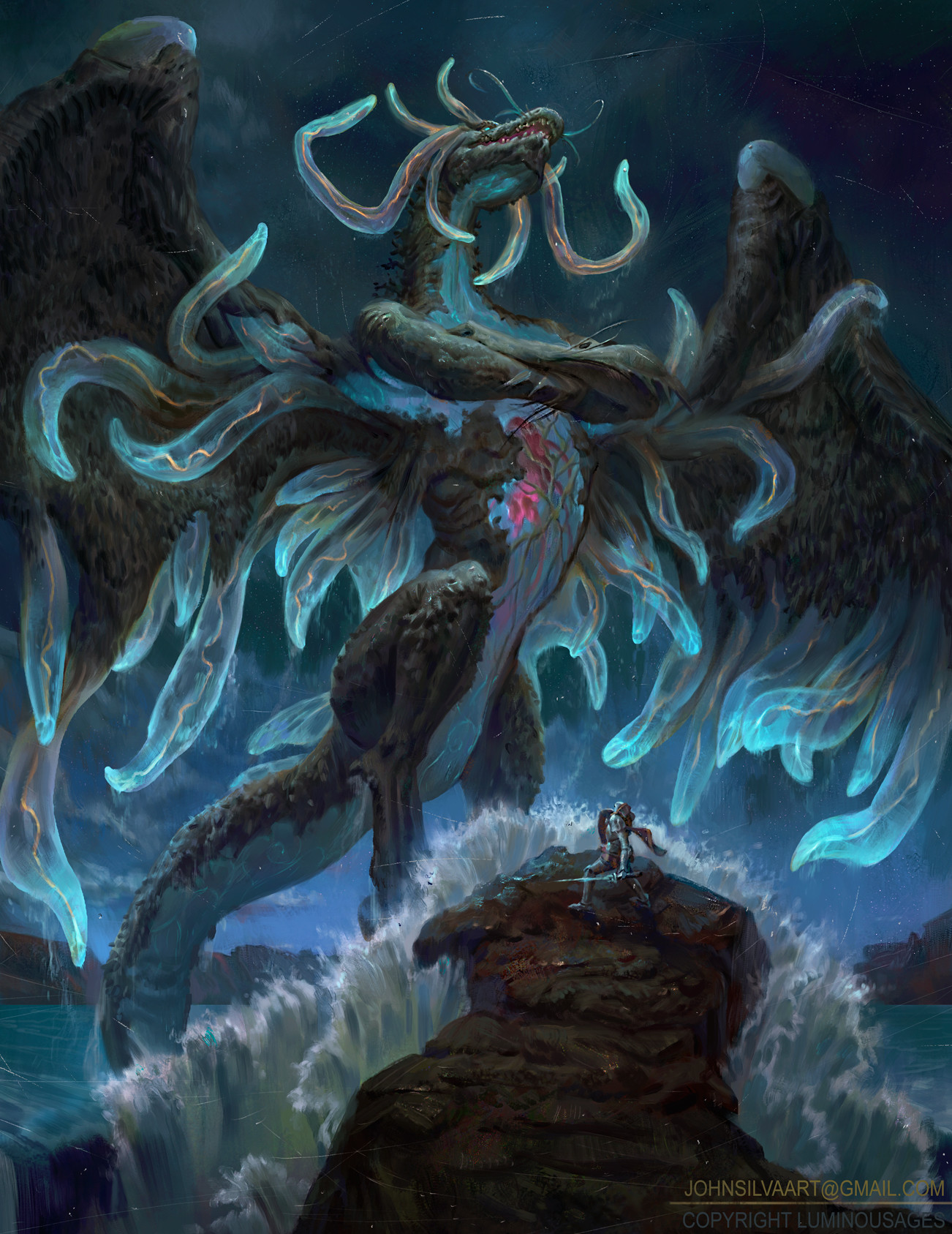
“Everyone warns ya to look to the skies when searching for dragons. No one ever mentions the ones that come from below.”
– An old townsfolk’s warning.
Well it wouldn’t be Dungeons and Dragons without some Dragons populating the monster compendiums would it? Before diving into the Abyssal Dragons, a few guidelines on how this post is going to go as Dragons in D&D are a special kind of monster. Most “true” dragons have multiple statblocks depending on the stage of their life they’re at when encountered. This starts at the lowest with Wyrmlings, progressing to Young Dragons, then Adult Dragons, and after that to Ancient Dragons, and then to the oldest level called Greatwyrms. Wyrmlings sit in the lower CRs (3-5), Young Dragons just above that (6-9), Adults are the first real challenge and a suitable boss monster (13-17), Ancients are campaign ending challenges (19-22), and Greatwyrms are for only the highest echelon of combat encounters (25+). As dragons age and grow in power, they gain new abilities and their prior ones enhance, growing more dangerous the larger and older they get. To prevent this blogpost from being a hour long read, i will be marking * to display which level of dragon has which feature using the key below:
- * – Wyrmlings
- ** – Young
- *** – Adult/Ancient
- **** – Greatwyrm
Not perfect, but it helps a bit. Now, without further delay, lets get to it!
Abyssal Dragons: The Overview
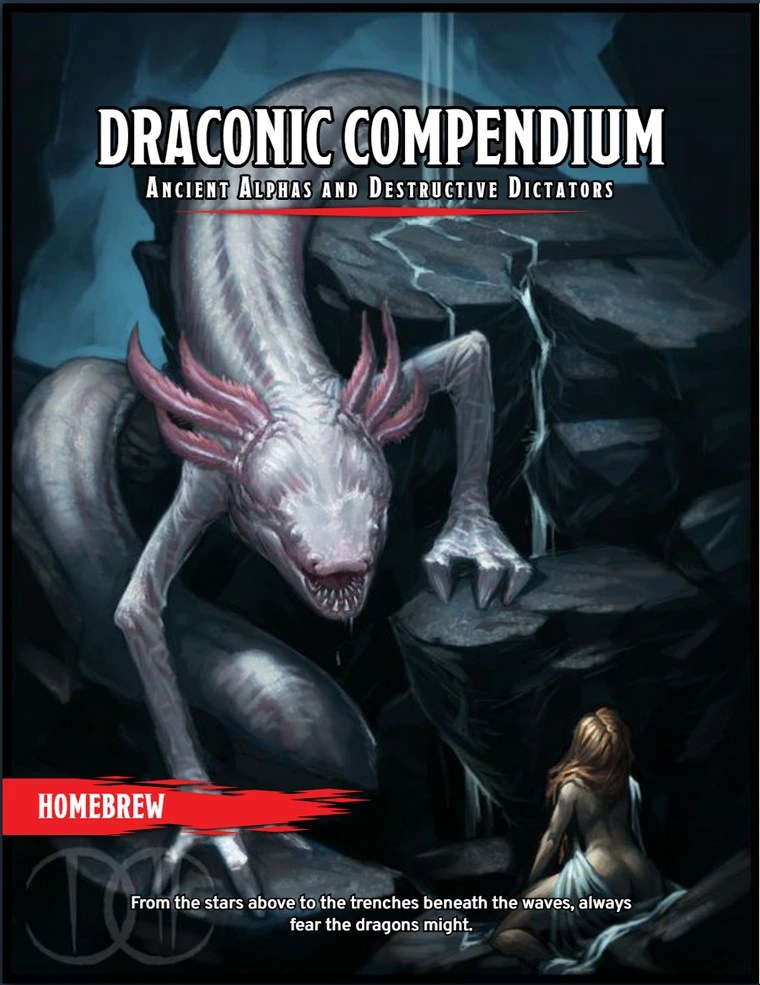
The first of the mighty Dragon Compendium, Abyssal Dragons make their nests and lairs deep under the ocean’s surface, using their aquatic prowess to hunt and defend their homes with terrifying prowess. While not one of the “Big Three” dragon types (Chromatic (Evil), Gemstone (Neutral), or Metallic (Good)), Abyssal Dragons are temperamental and somewhat aloof as a result of their isolationist natures. While residing deep underwater, these dragons are just as quick in the air as they are underwater so they have no qualms leaving the safety of the ocean floor and soaring into the sky if provoked or needing to make a hasty exit. As apex predators of the seas, Abyssal Dragons often feed on other massive sea creatures such as whales, Storm Giants, or even Krakens once strong enough.
Stats and Abilities:
While vastly different in strength between all the different ages, each of the Abyssal Dragon’s statblocks all point to it being a bruiser with its high STR and CON, yet unlike a decent chunk of bruiser type monsters, all of the Abyssal Dragon’s mental stats are above board and can lead to diplomatic solutions. Afterall, if there is one thing dragons love more than fighting, its tributes and adoration. Even if its secluded from the rest of the world and is a bit more “savage” than its other kin, a dragon is still a dragon.
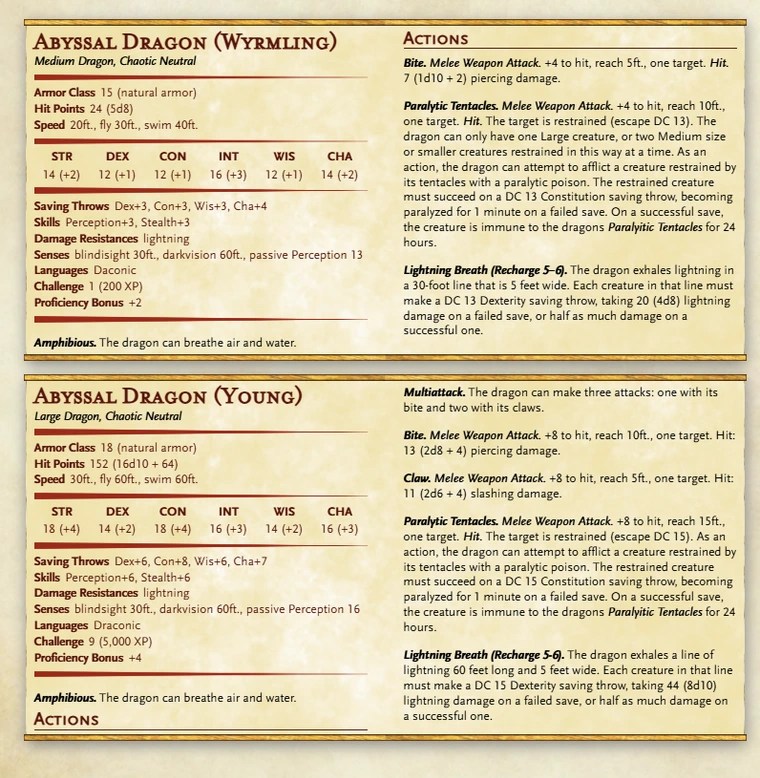
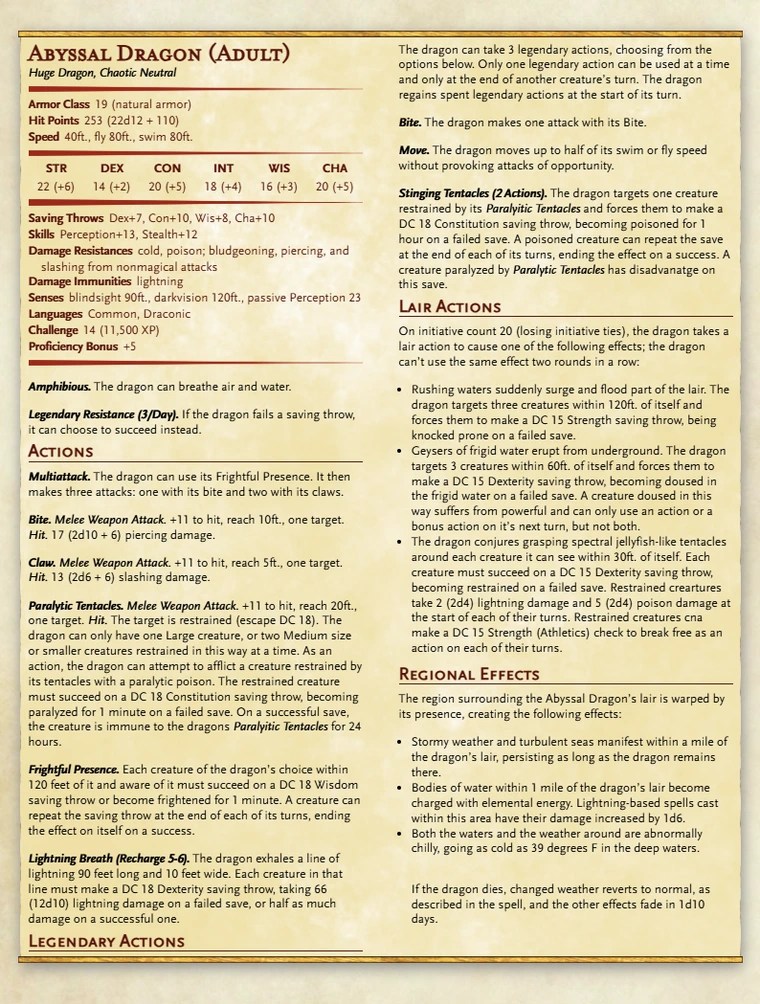

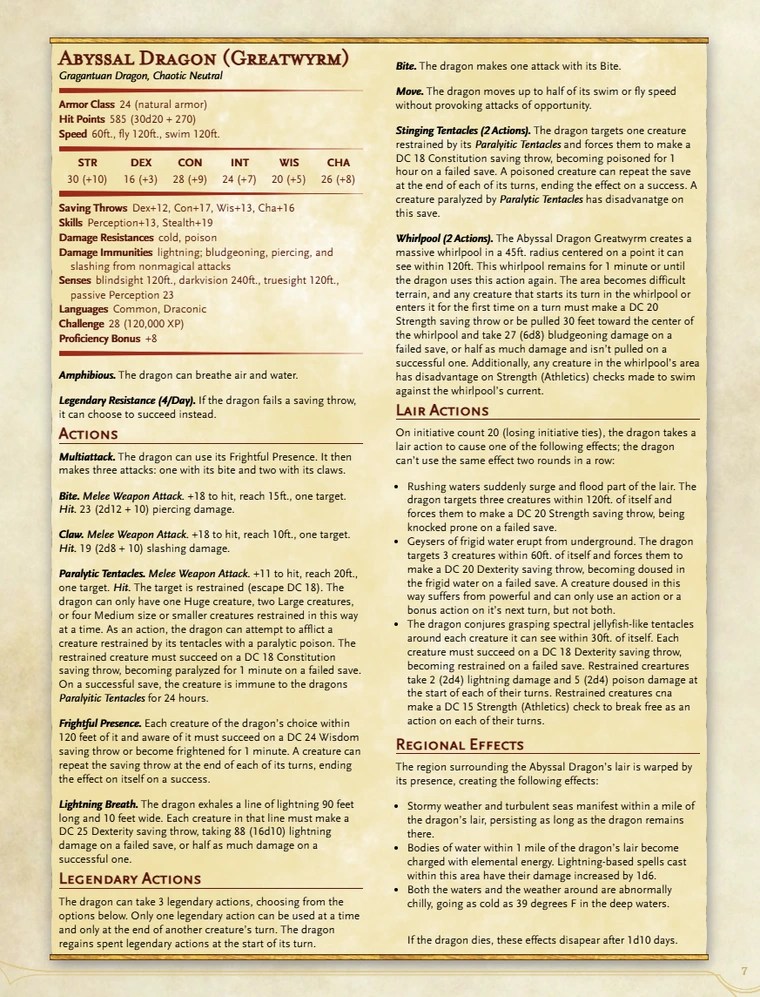
Dragons scarcely have weaknesses that are obvious in a statblock. More often than not, a dragon’s weakness is something in its personality. It’s vain and easily snaps when its character is questioned, they love gold and are easily swayed with monetary incentive, they were previously wounded severely in earlier events of the story so they avoid combat, etc. The weakest section in the statblock is the dragons still good DEX and WIS, as it is more often not relying on brute force due to its “feral” nature (when compared to other true dragons), yet thanks to its proficiency in those saving throws, along side CON and CHA, every level of this dragon is not going down without a fight or some good diplomacy (and probably groveling).
- Stats and Skills: As mentioned, having proficiency in four saving throws allows the dragon to act in a much more aggressive and sure manner during combat, not fearing offensive or utility spells. With a decent AC and fair hit points (especially in the weaker levels) it does fairly well in close quarters, but as a Wyrmling, it can be easily overwhelmed. Proficient in both Perception and Stealth allow the Abyssal Dragon to be somewhat of an ambusher, though even with that bonus because of its lower DEX/WIS scores it would still focus more on brute force rather than hit and run tactics in a fight.
- Resistances, immunities, and Senses: Being resistant to lightning initially and later gaining more while shifting to a lightning immunity, the older it gets the more resilient the dragon’s hide gets. In the upper tiers, being immune to lightning and resistant to cold, poison, and all nonmagical weapon attacks, the Adults, Ancients, and Greatwyrms have little to fear aside from the other CR 15-20+ creatures of the sea. Capable of taking on entire ships with little more than scratches unless said ship is specifically designed to fight them, in which they can slink away deep under the surface. Intelligent to boot, these dragons know when to abandon a fight or when to stop toying with their prey. Not having condition immunities such as frightened, poisoned, or charmed seems… odd? Already a revision that should happen, other Greatwyrms are immune to these conditions and I don’t think the Abyssal Dragons should be an exception to this.
Passive Abilities and Actions:

Amphibious. The dragon can breathe air and water.*
It’s kind of important to have an aquatic undersea dragon be able to breathe while underwater, and with its equally fast flying speed, there is no reason it wouldn’t have to also be able to breathe air.

Bite. Melee Weapon Attack. [ ] to hit, reach [ ]ft., one target. Hit. [ ] ([]) piercing damage.*
Obviously a Wyrmling’s bite isn’t going to hit nearly as hard as a Greatwyrms, so the to hit bonus, reach, and damage will all vary between the levels. Every dragon has a face full of sharp and pointy teeth, why not use it?

Paralytic Tentacles. Melee Weapon Attack. [ ] to hit, reach [ ]., one target. Hit. The target is restrained (escape DC [ ]). The dragon can only have one Large creature, or two Medium size or smaller creatures restrained in this way at a time.
As an action, the dragon can attempt to afflict a creature restrained by its tentacles with a paralytic poison. The restrained creature must succeed on a DC [ ] Constitution saving throw, becoming paralyzed for 1 minute on a failed save. On a successful save, the creature is immune to the dragons Paralytic Tentacles for 24 hours.*
The big gimmick of the Abyssal Dragon line, using the myriad of jellyfish-like tentacles across its body to grab, restrain, and paralyze their targets. As they grow larger, the difficult of escaping grows, the range they can attack at increases, and with Greatwyrms the size of creatures they can restrain also increases. This is an incredibly dangerous ability with how debilitating the paralyzed condition in D&D is (Incapacitated (cannot take actions or bonus actions, cannot speak, or concentrate on spells), movement drops to 0ft., automatically fail on STR and DEX saving throws, all attack rolls roll at advantage, and creatures that hit a paralyzed creature within 5ft. automatically critically hit), that is why once a creature saves, it is immune to the effects of Paralytic Tentacles for 24 hours. Otherwise, a whole party is gonna go down paralyzed and slowly get crit to death by the dragon, and that’s no fun.

Lightning Breath (Recharge 5–6). The dragon exhales lightning in a [ ]-foot line that is 5 feet wide. Each creature in that line must make a DC [ ] Dexterity saving throw, taking [ ] ([ ]) lightning damage on a failed save, or half as much damage on a successful one.*
It wouldn’t be a dragon statblock if it didn’t have a breath weapon now would it? With the main focus on Abyssal Dragons being their jellyfish tentacles and their tendency to reside in stormy seas, lightning felt like the best selection for a breath weapon attack. While poison might have also worked since that’s what a jellyfish toxin is, in fantasy settings it feels more appropriate that a jellyfish’s sting “shocks” you instead and thus would deal lightning damage

Multiattack. The dragon can make three attacks: one with its bite and two with its claws.**
Aside from the Wyrmling, every other level of the Abyssal Dragon gains the Multiattack feature as it is a necessity to compete with adventuring parties the higher and higher level you go.

Claw. Melee Weapon Attack. [ ] to hit, reach [ ]ft., one target. Hit: [ ] ([ ]) slashing damage.**
Similar to bite, if you have razor sharp claws, why not use them? Dragons are prideful creatures and while they could spend the entire combat flying and raining fire, acid, poison, or whatever else from their maws, its more fun to strike your enemies with your own hands, at least if you’re a building sized lizard with swords for claws.

Legendary Resistance ([ ] /Day). If the dragon fails a saving throw, it can choose to succeed instead.***
Surprise surprise, the all powerful dragon is a legendary creature in its older age. Like the last legendary creature mentioned a couple weeks ago, the celestial Absolution, Abyssal Dragons have such good stats and saving throws that if they fail one, they’re going to just expend a usage of one of their Legendary Resistances to pass.

Frightful Presence. Each creature of the dragon’s choice within 120 feet of it and aware of it must succeed on a DC [ ] Wisdom saving throw or become frightened for 1 minute. A creature can repeat the saving throw at the end of each of its turns, ending the effect on itself on a success.***
Frightful Presence is a staple ability for any dragon once they reach adulthood and just about every “true dragon” has this feature (though for some reason, the Greatwyrms form Fizban’s Treasury of Dragons doesn’t). This is the first thing a dragon will do in combat as the frightened condition prevents creatures from approaching any closer than they already are and they suffer disadvantage on ability checks and attack rolls while the source of the frightened condition is within line-of-sight. For this reason, an Abyssal Dragon’s main arena is likely to be a spacious cavern with minimal hiding spots, thus its always within line of sight. Additionally, this arena style allows the dragon’s Lightning Breath to meet its maximum range without being blocked by stray pillars or walls.

Legendary Actions: The dragon can take 3 legendary actions, choosing from the options below. Only one legendary action can be used at a time and only at the end of another creature’s turn. The dragon regains spent legendary actions at the start of its turn.***
Just like Absolution, Abyssal Dragons gain three Legendary Actions per round they can use after another creatures turn. The Abyssal Dragon gets the following Legendary Actions:
Bite. The dragon makes one attack with its Bite.***
A standard Legendary Action. No notes.

Move. The dragon moves up to half of its swim or fly speed without provoking attacks of opportunity.***
Most other dragons have their Wing Attack that deals damage to everything around them and then allows them to move freely, but with the design and aesthetic of the Abyssal Dragons I just don’t get that. While not super dexterous, I feel as though the dragon has no difficulty to slip out without provoking attacks of opportunity.
Stinging Tentacles (2 Actions). The dragon targets one creature restrained by its Paralytic Tentacles and forces them to make a DC 18 Constitution saving throw, becoming poisoned for 1 hour on a failed save.
A poisoned creature can repeat the save at the end of each of its turns, ending the effect on a success. A creature paralyzed by Paralytic Tentacles has disadvantage on this save.***
So remember that brief blurb earlier about how when a jellyfish “shocks” you its actually a toxin? Well the Abyssal Dragon can do something similar. The poisoned condition in D&D is more of a nuisance than a threatening debilitation like the paralyzed condition. It’s still bad as it forces disadvantage on ability checks and attack rolls, and if you have a low CON, that hour long timer could lead to multiple combats suffering under its effects (if the DM is mean enough to throw more combat encounters after an Adult Dragon that is). This can technically be a nasty feature as if the dragon successfully grapples a creature, it can wait until the end of the next turn in the initiative and immediately try and poison the creature it restrained, but thankfully poisoned creatures can repeat the save at the end of each of their turns, so chances are they will get out of it in time.

Whirlpool (2 Actions). The Abyssal Dragon Greatwyrm creates a massive whirlpool in a 45ft. radius centered on a point it can see within 120ft. This whirlpool remains for 1 minute or until the dragon uses this action again.
The area becomes difficult terrain, and any creature that starts its turn in the whirlpool or enters it for the first time on a turn must make a DC 20 Strength saving throw or be pulled 30 feet toward the center of the whirlpool and take 27 (6d8) bludgeoning damage on a failed save, or half as much damage and isn’t pulled on a successful one. Additionally, any creature in the whirlpool’s area has disadvantage on Strength (Athletics) checks made to swim against the whirlpool’s current.****
This legendary action is exclusive to the Greatwyrm statblock and is definitely something that needs some tweaking. Currently, it’s best used in a strictly underwater location so the open cavern idea from earlier doesn’t make this too applicable unless the whirlpool actively replaces terrain. So for example, it creates a 45ft. radius and any creatures in that area fall into a turbulent whirlpool, suffering the effects as normal. Another revision that might need to be made is that a 45ft. radius is massive AoE and unless you’re in an absolutely gargantuan combat map, there is nowhere this won’t cover. Limiting the AoE down to even 30ft. or 25ft would drastically help balance this so its not guaranteed to immediately get everybody in the whirlpool.

Lair Actions: On initiative count 20 (losing initiative ties), the dragon takes a lair action to cause one of the following effects; the dragon can’t use the same effect two rounds in a row: ***
- The dragon conjures grasping spectral jellyfish-like tentacles around each creature it can see within 30ft. of itself. Each creature must succeed on a DC 18 Dexterity saving throw, becoming restrained on a failed save. Restrained creatures take 2 (1d4) lightning damage and 5 (2d4) poison damage at the start of each of their turns. Restrained creatures can make a DC 15 Strength (Athletics) check to break free as an action on each of their turns.
- Rushing waters suddenly surge and flood part of the lair. The dragon targets three creatures within 120ft. of itself and forces them to make a DC 18 Strength saving throw, being knocked prone on a failed save.
- Geysers of frigid water erupt from underground. The dragon targets 3 creatures within 60ft. of itself and forces them to make a DC 18 Dexterity saving throw, becoming doused in the frigid water on a failed save. A creature doused in this way suffers from powerful and can only use an action or a bonus action on it’s next turn, but not both.
Sound the victory bells, we got the first our first monster with Lair Actions! Unsurprisingly, creatures of world famous renown and myth have entire dungeons and areas they’ve claimed which aid them with bonuses and additional actions/effects. More often than not, these effects originate from the environment itself and not the creature who owns the lair, however they still choose the effect. Lair Actions happen on initiative count 20 (or more often, top of initiative) and the creature who owns the lair can choose one of the three actions each turn, rarely able to use the same one multiple rounds in a row. Nothing across these abilities is meant to be nearly as detrimental as the main features of the Abyss Dragon, but they still need to support the dragon in some way so that’s why there’s no “big damage” option and all are geared for support usage.

Regional Effects: The region surrounding the Abyssal Dragon’s lair is warped by its presence, creating the following effects:
- Both the waters and the weather around are abnormally chilly, going as cold as 39 degrees F in the deep waters.
- Stormy weather and turbulent seas manifest within a mile of the dragon’s lair, doubling the amount of time it takes to travel by sea within the area.
- Bodies of water within 1 mile of the dragon’s lair become charged with elemental energy. Lightning-based spells cast within this area have their damage increased by 1d6.
- If the dragon dies, changed weather reverts to normal, as described in the spell, and the other effects fade in 1d10 days.
And with Lair Actions come another perk, after all if you’re some master of the area, powerful enough to literally carve a place out for yourself and bend the realm to your whim, why not right? Regional Effects are specifically for high end monsters that have a lair, but not every creature that has a lair gets Regional Effects. Usually it’s only if said creature has the power to warp the environment due to its sheer existence, and dragons fit that mold to the letter. No Regional Effect should have a tremendous impact on the party or be particularly threatening/dangerous, but they should at least have an impact and change how the party approaches either just passing through the lair’s area, or marching up to the front door.
Revisions:
All in all, I’m much happier with this statblock than with a couple of the others in the prior weeks as despite their majesty and roll in a story, dragons are actually relatively simple creatures to formulate a statblock for. The biggest change I have is for the Greatwyrm’s Whirlpool Legendary Action as with the current wording, it seems only applicable for underwater application and I would like it to be applicable everywhere it can be. Whether this is creating more of a tornado as it fills a cylindrical area or it replaces the ground underneath, I have yet to decide. Regardless, I am much happier with this after some editing before making this post as the initial statblock was a bit of a mess, but hey, you live and you learn right?
Well that wraps up this week’s D&D Homebrew Monster of the Week, stay tuned next time when we discuss a golden elemental of myth! In regards to other content and the D&D Intro to the character sheet, they are still a WIP. I do have other plans outside the D&D sphere, but it will not be as consistent as this content currently, so please be patient and thank you again for any and all support!
 The Speer-Head Lounge