“Whoa! Check this out!”
“Wow… It’s a whole legion of golden statues. They’re so realistic too… A bit too realistic. Take a look at the faces. No way someone spent that long carving that level of detail.”
“Well come on! If someone can spend this much gold for just statues, they gotta be beyond loaded! Haha! We’re gonna need more wagons!”
“I’m not too sure about this…”
– Final conversation of two dungeon delvers.
Leave it to D&D to even have the rocks be threatening creatures. Just typical… The first Elemental we got on the plate is the Aurelionite, which fun fact shares its name to the somewhat secret boss in the extremely popular (and a beloved game of mine) Risk of Rain 2 which is also a towering rocky/golden elemental. The Aurelionite is a special kind of monster, because unlike every other we have covered so far, it WILL NOT EVER be found outside its lair. Honestly, despite being nowhere close to the Abyssal Greatwyrm’s CR, this might be the most dangerous monster shown up until this point and for a good bit more.
Aurelionite: The Overview
Elementals can typically be found in one of 4 elements: Air, Earth, Fire, and Water. Now these can have sub-categories, but typically its one of these four. Aurelionite obviously falls entirely into the Earth Elemental genre and as such it I designed a few “rules” for it to follow: Slower than other creatures of its caliber and giving it a chunky AC and hit point pool. This is not meant more so to be an obstacle than a creature in a way as it will never leave its Lair, and as such will never be a persistent threat to the party but rather a final test/challenge for a party through a difficult dungeon. I envisioned the Aurelionite as a tragic creature due to its most dangerous feature being ripped straight from the tale of King Midas from Greek mythology. It’s cognizant of its destructive power and thus holes itself away, only attacking those who have found it to try and hide its secret.
Stats and Abilities:
With high STR, CON, and WIS, solid INT and middling DEX and CHA, the Aurelionite is designed to be a bruiser with hit points to spare. While its INT is not bad, with a 20 in WIS the Aurelionite cannot be tricked or ambushed easily, and while diplomacy will rarely work for a creature determined to keep itself hidden, it’s not impossible to reason with.
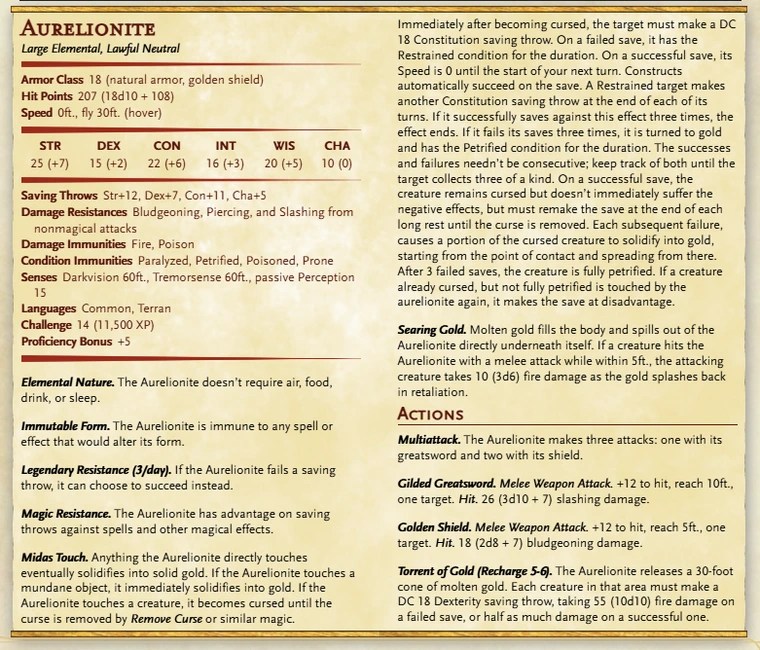
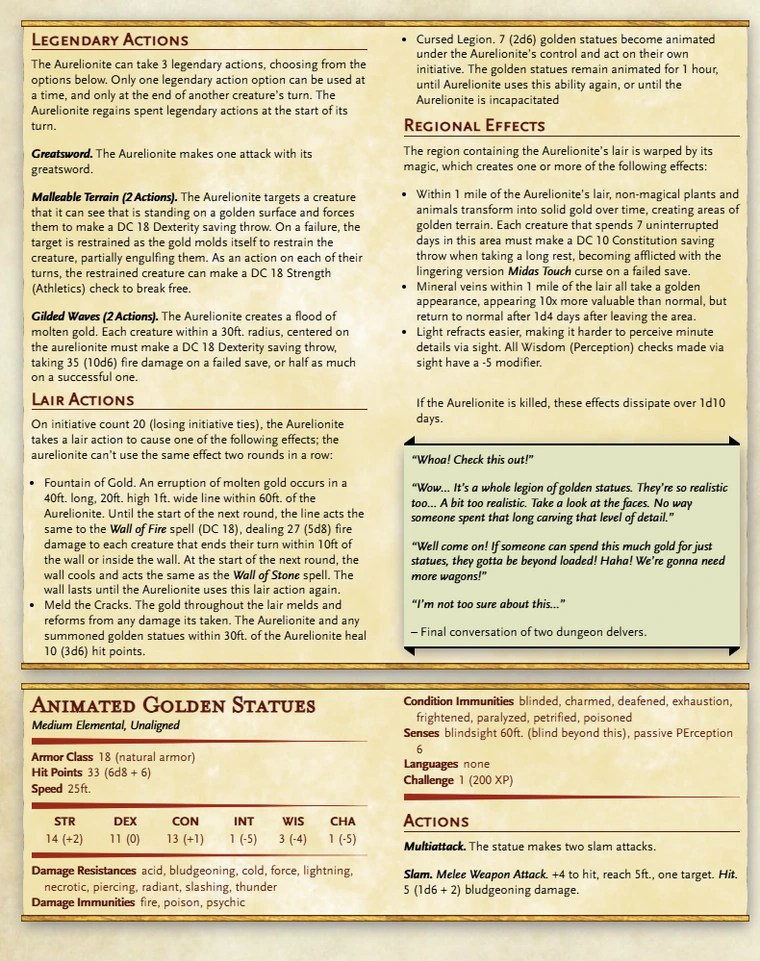
This thing is a bulky behemoth in combat, sporting an 18 AC and over 200 hit points, this goliath will not be tapping out anytime soon. With a Lawful Neutral alignment, its not inherently good or evil, but instead following its own ideology and acting in its own interest. Its still honorable, abiding by the rules it has in place of itself, but these rules are not strictly malevolent or benign. As mentioned, it doesn’t want to be freed. If you’re nearby but don’t venture into the center of its lair and leave, all good. If you encounter it and try to escape, it will hunt you down until it is too risky to pursue.
- Stats and Skills: With proficiency in four saving throws, STR is not as important as the other three as typically a STR check is to breaking free of restraint or avoiding being moved against your will/knocked prone (the latter which the Aurelionite is outright immune to). DEX and CHA are great because these are the Aurelionite’s lowest stats and as such need to be helped as spells/effects that require these saves are typically big damaging spells such as Lightning Bolt or effects that remove Aurelionite from the battle outright such as Banishment. While lacking any skill proficiencies, the Aurelionite is no fool and naturally is guarded. Paired with Magic Resistance makes it so most other utility or control spells likely won’t be effective against it.
- Resistances, Immunities, and Senses: Resisting all nonmagical weapons and being immune to both Fire and Poison damage is very on brand as while gold itself isn’t the most resilient material, you can’t poison a rock, its got molten gold spilling from its body, and it is at the end of the day a pile of gold covered boulders. Additionally, its common for most elementals to be immune to a plethora of conditions, and with rock-themed elementals specifically i find it hard to paralyze a pile of rocks, you cant petrify it because it is already stone, it cant be poisoned because… rocks…, and it cant be knocked prone because its hovering in the air. Having Darkvision makes a lot of sense as this is a creature that resides deep in gilded caves, isolated from the outside, but Tremorsense… Tremorsense is the ability to detect vibrations through the earth which makes sense for a creature that is comprised of earth, there’s just one problem… With the fact the Aurelionite’s only movement option is to hover through the air, its not going to be on the ground. With that, I might instead bump Darkvision up to 120ft. and remove Tremorsense, but thats a change for a later day.
Passive Abilities and Actions

Elemental Nature. The Aurelionite doesn’t require air, food, drink, or sleep.
Just like a lot of other creatures, the Aurelionite doesn’t need food or anything of the like. After all… its a pile of golden rocks…

Immutable Form. The Aurelionite is immune to any spell or effect that would alter its form.
Just like most constructs, the Aurelionite cannot have its form altered in anyway, preventing a lot of cheap and easy solutions (though between magic resistance and Legendary Resistances, this wouldn’t be likely anyways).

Legendary Resistance (3/day). If the Aurelionite fails a saving throw, it can choose to succeed instead.
Just like the other big bosses shown off, this is a staple that is required for end-game level monsters. Additionally, due to its bonuses and saving throw proficiency, its likely to use this whenever it fails a save (minus a STR saving throw)

Magic Resistance. The Aurelionite has advantage on saving throws against spells and other magical effects.
Big boon to have against spellcasters and a necessary aid to help avoid the upper tier magic spells.
Midas Touch. Anything the Aurelionite directly touches eventually solidifies into solid gold. If the Aurelionite touches a mundane object, it immediately solidifies into gold.
If the Aurelionite touches a creature, it becomes cursed until the curse is removed by Remove Curse or similar magic. Immediately after becoming cursed, the target must make a DC 18 Constitution saving throw. On a failed save, it has the Restrained condition for the duration. On a successful save, its Speed is 0 until the start of the Aurelionite’s next turn. Constructs automatically succeed on the save. A Restrained target makes another Constitution saving throw at the end of each of its turns. If it successfully saves against this effect three times, the effect ends. If it fails its saves three times, it is turned to gold and has the Petrified condition for the duration. The successes and failures needn’t be consecutive; keep track of both until the target collects three of a kind. On a successful save, the creature remains cursed but doesn’t immediately suffer the negative effects, but must remake the save at the end of each long rest until the curse is removed. Each subsequent failure, causes a portion of the cursed creature to solidify into gold, starting from the point of contact and spreading from there. After 3 failed saves, the creature is fully petrified. If a creature already cursed, but not fully petrified is touched by the Aurelionite again, it makes the save at disadvantage.
So we go from several abilities we have already covered and are simple, one sentence description to something that rivals Homer’s The Odyssey… Typical. Well buckle in, this is a doozy. To simplify it down, essentially this is the Midas Touch from Greek mythology; anything that King Midas touched is turned to gold. Now, in a game setting that’s not fun to deal with as there’s no counterplay to “I touch you and you’re petrified now :),” so instead it functions similarly to the Flesh to Stone spell. When a creature is directly touched by the Aurelionite (not through one of its attacks), its speed is reduced to 0 for that round and it makes the CON save and one of two things happens:
– Failure – It becomes partially restrained as its body slowly solidifies into gold. It repeats the saving throw until it either has three failures or three successes, becoming fully petrified on three failed saves or ending the effect on a success.
–Success– It still becomes cursed until it passes three saving throws, however these only occur once per day and at the end of a long rest (or until the curse is removed). Again, three failures leads to petrification and three successes ends the effect. Additionally, if a creature that initially passed the save (and is suffering the lingering effects of the curse) is touched by the Aurelionite again, it makes the save at disadvantage this time.

Searing Gold. Molten gold fills the body and spills out of the Aurelionite directly underneath itself. If a creature hits the Aurelionite with a melee attack while within 5ft., the attacking creature takes 10 (3d6) fire damage as the gold splashes back in retaliation.
A penalizing retaliatory feature to dissuade constant close-quarters aggression and to help chip at the frontliners. Equal damage to the CR 11 Remhorahz, so it feels very much in line difficulty wise. Not the most fun ability for players, but its thematic.

Multiattack. The Aurelionite makes three attacks: one with its greatsword and two with its shield.
This needs to be re-flavored some as despite it being a higher-end monster which frequently have more than two attacks, something this bulky, slow (compared to other CR 14s), and deliberate should only have two swings. Additionally with a new idea I have for the Shield attack, it should only be able to use it once per turn.
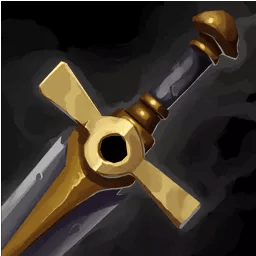
Gilded Greatsword. Melee Weapon Attack. +12 to hit, reach 10ft., one target. Hit. 26 (3d10 + 7) slashing damage.
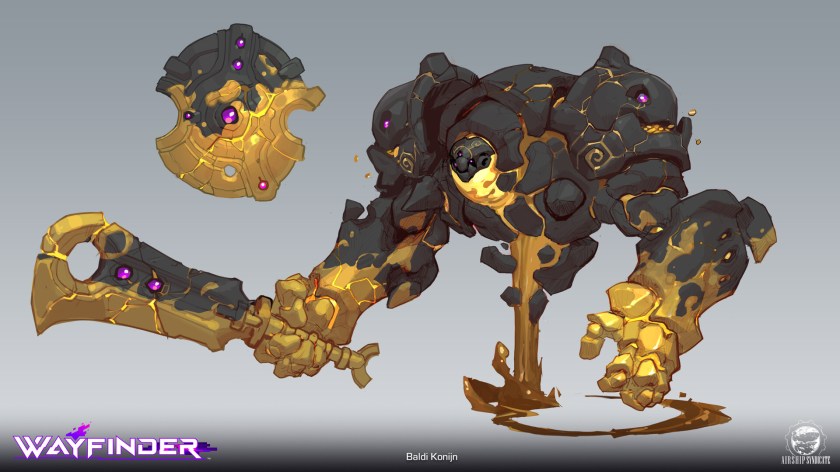
A friend of mine gave me an idea I might adopt. In the artwork for the Aurelionite, gold covers the edge of the blade and so it could have caused the weapon to go from a sharp bladed weapon to more of a club. Minor flavor change, but a fun idea. Otherwise, this is just a normal attack, though the damage will likely be increased when dropping the amount of attacks Multiattack allows. It varies slightly, but around CR 14, a creature should deal ~40 damage per turn with a multiattack.

Golden Shield. Melee Weapon Attack. +12 to hit, reach 5ft., one target. Hit. 18 (2d8 + 7) bludgeoning damage.
So… It turns out initially the Aurelionite was doing ~60 damage per turn… ahem… So this damage will actually be lowered as the new idea I had was allowing the Aurelionite to knock a target prone (provided the target fails a STR save) with the shield attack. This allows it to follow up with the greatsword attack at advantage (so long as the Aurelionite is no more than 5ft away).
Torrent of Gold (Recharge 5-6). The Aurelionite releases a 30-foot cone of molten gold. Each creature in that area must make a DC 18 Dexterity saving throw, taking 55 (10d10) fire damage on a failed save, or half as much damage on a successful one.
Typical with end-game monsters, the Aurelionite comes packing a nuclear deterrent similar to a dragon’s breath weapon feature and packs a solid punch. Otherwise, not too interesting. Could lower the damage and have it be a possible restrain mechanic, but I don’t want to do too much at once because it’s not really fun for anyone if a monster has three effects off of one feature and Midas Touch is already pushing it.

Legendary Actions: The Aurelionite can take 3 legendary actions, choosing from the options below. Only one legendary action option can be used at a time, and only at the end of another creature’s turn. The Aurelionite regains spent legendary actions at the start of its turn.
The Aurelionite has the following Legendary Actions:
Greatsword. The Aurelionite makes one attack with its greatsword.
Nothing to really note with this. Typical, on brand attack costing one Legendary Action.
Malleable Terrain (2 Actions). The Aurelionite targets a creature that it can see that is standing on a golden surface and forces them to make a DC 18 Dexterity saving throw. On a failure, the target is restrained as the gold molds itself to restrain the creature, partially engulfing them.
As an action on each of their turns, the restrained creature can make a DC 18 Strength (Athletics) check to break free.
An area control ability to help halt advancing players and allow it (or any summoned allies) free reign for a bit. Chances are, anything in this area either has a good enough DEX to avoid the initial save, or has a high enough STR to break free quickly on following turns.
Gilded Waves (2 Actions). The Aurelionite creates a flood of molten gold. Each creature within a 30ft. radius, centered on the Aurelionite must make a DC 18 Dexterity saving throw, taking 35 (10d6) fire damage on a failed save, or half as much on a successful one.
To be perfectly honest, I’m not super thrilled about this feature as it feels too similar to Torrents of Gold. A 30ft. AoE that deals fire damage, but again and in a different shape with less damage. This is subject to being tweaked and changed, but to what yet I do not know.

Lair Actions: On initiative count 20 (losing initiative ties), the Aurelionite takes a lair action to cause one of the following effects; the aurelionite can’t use the same effect two rounds in a row:
- Fountain of Gold. An eruption of molten gold occurs in a 40ft. long, 20ft. high 1ft. wide line within 60ft. of the Aurelionite. Until the start of the next round, the line acts the same to the Wall of Fire spell (DC 18), dealing 27 (5d8) fire damage to each creature that ends their turn within 10ft of the wall or inside the wall. At the start of the next round, the wall cools and acts the same as the Wall of Stone spell. The wall lasts until the Aurelionite uses this lair action again.
- Meld the Cracks. The gold throughout the lair melds and reforms from any damage its taken. The Aurelionite and any summoned golden statues within 30ft. of the Aurelionite heal 10 (3d6) hit points.
- Cursed Legion. 7 (2d6) golden statues become animated under the Aurelionite’s control and act on their own initiative. The golden statues remain animated for 1 hour, until the Aurelionite uses this ability again, or until the Aurelionite is incapacitated
Each of these Lair Actions offer a large boon for the Aurelionite’s options; creating semi-permanent effects in the arena to wall off opponents from allies or simply create space if needed, heal a moderate amount of hit points to help sustain the fight, and finally to allow for allies to join the fray and help take hits. Just a little bit of everything at its disposal and that really helps elevate the Aurelionite from a challenging boss to something really special and memorable (and dangerous).

Regional Effects: The region containing the Aurelionite’s lair is warped by its magic, which creates one or more of the following effects:
- Within 1 mile of the Aurelionite’s lair, non-magical plants and animals transform into solid gold over time, creating areas of golden terrain. Each creature that spends 7 uninterrupted days in this area must make a DC 10 Constitution saving throw when taking a long rest, becoming afflicted with the lingering version Midas Touch curse on a failed save.
- Mineral veins within 1 mile of the lair all take a golden appearance, appearing 10x more valuable than normal, but return to normal after 1d4 days after leaving the area.
- Light refracts easier, making it harder to perceive minute details via sight. All Wisdom (Perception) checks made via sight have a -5 modifier.
If the Aurelionite is killed, these effects dissipate over 1d10 days.
Like most Regional Effects, these will have little outcomes during a battle, though the final one should be tweaked and reworded as a flat -5 to perception is very strict for just being in the area (which is also an undisclosed amount of land).
Revisions:
While I’m happy that this statblock doesn’t feel obscene or completely imbalanced, I would be lying if I said it was perfect. Midas Touch I feel needs to have its DC lowered and possibly reworded to make it easier to comprehend that way it doesn’t automatically petrify the low CON casters in the back, who would be the answer to free anyone else cursed. Additionally, there needs to be clarification on how exactly the Aurelionite touches another creature. Is it a DEX save? Is it an attack roll? Does it just happen? So there’s a lot of missing info. Gilded Waves I’m sure will be reworked into something else down the line, but again I’m not sure what to. Finally, the more I think about the lingering effects of the Midas Touch effect, the more i dislike it so I will probably be removing that section and just have it function akin to the Flesh to Stone spell.
I’m still very happy with how this turned out and am content with the fact it’s not as dangerous as it could have been. A lot of work needs to happen before it’s as good as it can be, but all in all, not too bad if I say so. Well, that’s all this week, so tune in next time when we cover the infernal and abyssal beings of sin: The Fiends!
 The Speer-Head Lounge