CONSTRUCTION UNDERWAY!
Do not feed, pet, or otherwise distract the Bagworm Builders from their work. 150gp fine for first offense.
– Sign posted by a local guild handling construction of a new building.
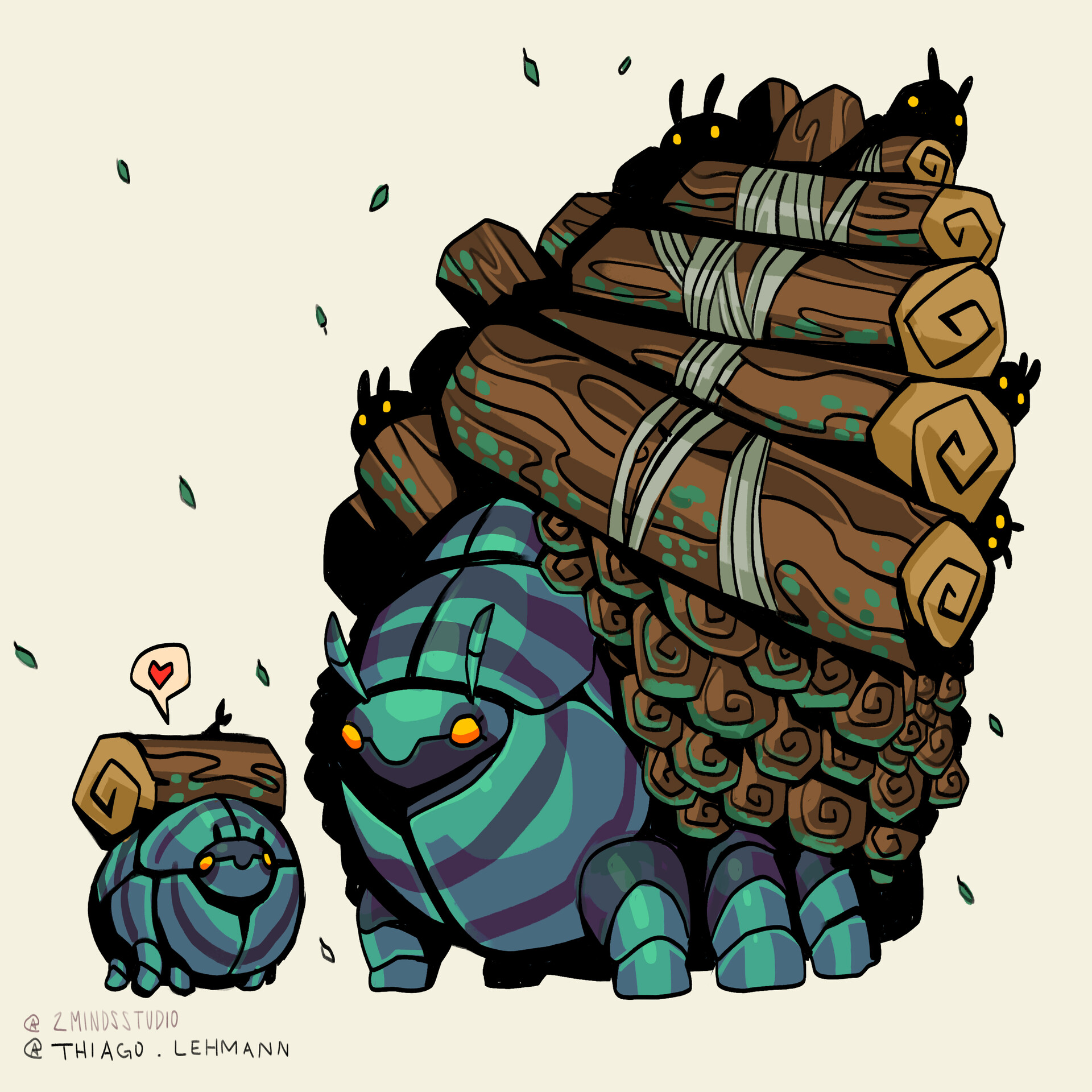
Back again with another big ol’ beastie: The Bagworm Builders! These are massive insects that reside in forested regions, creating tough shells by weaving fallen trees and logs together on to it’s back. These “shells” often also act as nurseries for the Bagworm Builder’s young. While I do love these from a lore and worldbuilding standpoint, to call their statblocks perfect would be sadly incorrect.
Bagworm Builders: The Overview
Large almost caterpillar like beetles, Bagworm Builders use their massive and razor sharp mandibles to easily cut through logs and trees before webbing them to the complex shells they carry on their back. Again while I love this idea, their actual statblock does nothing to actively lean into this idea so a hefty amount of revisions are needed. I imagine these creatures to travel in large herds, carving paths through forests and leaving rows of tree stumps in their wake. Relying more on their resilient shells rather than the wooden fortresses upon their backs, Bagworm Builders are slow but powerful lumbering beasts, though still often timid and docile compared to many other creatures within D&D, being used as beasts-of-burden by local farmers and villages on the outskirts of forests.
Stats and Abilities

Bagworm Builders are bulky beasts of burden who use their large frames and powerful jaws to split trees before webbing them to their exterior carapaces to serve as additional “shells”. Sadly, the stat-spread only somewhat leans into this. The Bagworm Builders depend heavily on STR and CON as they should but that’s as far as it goes. In all honesty, I feel as though their DEX needs to be lowered slightly to showcase the lumbering nature of these beasts and a WIS of 13 means their craftier then they should be. I think 8 DEX, 8 WIS, and 5 CHA would be a better fit as while their CHA already isn’t great and they live in groups, 5 CHA puts them around the same level as Cows which feels in line. Additionally this doesn’t feel like a CR 4, especially after the last post with the Aberrant Hound being the same difficulty and having a lot more of a kit to back it up. This feels more in line with a CR 2 to be perfectly honest.
- Stats and Skills: Boasting a really solid STR and CON for this early of a level, Bagworm Builders are simple beasts, using their overwhelming size and strength to push back predators and attackers. Because they aren’t especially mobile (especially after adding several trees worth of logs to their shells), these creatures would likely fight to the death before fleeing as they don’t have the fattest run speed and would be outran by almost everything else. Granted, 25ft. isn’t a bad movement speed, but I will likely adjust it to around 20ft. to help reflect their more lumbering nature. Boasting no additional Saving Throws or Proficiencies, this is a simple creature with a simple mind and simple needs.
- Resistances, Immunities, and Senses: With only a measly resistance to Poison damage, the Bagworm Builder relies on it’s AC and hit points above anything else. This could be likely tweaked after leaning more into the shell of trees Bagworm Builders would build as that could temporarily allow for resistance to nonmagical weapon attacks while now being vulnerable to Fire damage due to the wood and webs being flammable. Otherwise, a 60ft. Darkvision doesn’t really change too much for this creature. Relying on its size and numbers, that doesn’t really change whether it’s night or day and the Bagworm Builder isn’t an ambush predator seeking out to get the jump on unsuspecting prey.
Passive Abilities and Actions:

Beasts of Labor. The Bagworm Builder can carry up to 1,500 pounds of logs or other materials on its back. It can still climb and move at full speed with this weight.
In all honesty, while it’s nice that this ability spells out what exactly how much weight and strength a Bagworm Builder is boasting, this first is shooting way underneath what a beats of this size should be able to pull (full grown ox can pull upwards of 2x this amount) and secondly it doesn’t add much importance to the actual statblock. It’s a good reference to keep in mind what the Bagworm Builder should be able to move, but I doubt players are going to dive headfirst and argue that a tree or rock might be too large for this to move if it seems feesible.

Sticky Silk. The Bagworm Builder can use its sticky silk to create structures or webbing that can support up to 2,000 pounds of weight. The silk can be destroyed with fire as per the Web spell.
Similar to Beast of Burden, this feature doesn’t seem to bring too much to the table and is also just not framed correctly. A creature of this size could easily spin webs capable of holding up several tons as opposed to the meager 2,000lbs. Again, this is great for a frame of reference, but isn’t explicitly needed in the statblock. If a creature should be able to and/or need to pull several tons of logs for a shell, it should be able to in the realm of fantasy.

Bite. Melee Weapon Attack: +4 to hit, reach 5ft., one target. Hit 8 (1d8 + 4) piercing damage plus 4 (1d8) poison damage.
A standard bite attack. Nothing about the Bagworm Builder screams venomous or any ability to withstand poisons so I will be revising this to deal only piercing damage. If I lower the CR down to 2, the damage will likely remain as is, maybe increasing slightly to help compensate for the lack of poison damage. This is the creatures only offensive measure and so it should have some oomph behind it, especially since this creature can feel trees.

Web Shot. Ranged Weapon Attack: +4 to hit, range 20ft./80ft., one target. Hit The target is restrained (Escape DC 13).
I’m usually pretty good about explaining more intricate abilities in greater detail so I am unsure why this one was so… lackluster. I think a better description would be as follow:
Web (Recharge 5–6). Ranged Weapon Attack: +3 to hit, range 30/60 ft., one creature. Hit: The creature is restrained by webbing. As an action, the restrained creature can make a DC 13 Strength check, escaping from the webbing on a success. The effect also ends if the webbing is destroyed. The webbing has AC 10, 5 hp, vulnerability to fire damage, and immunity to bludgeoning, poison, and psychic damage.
Revisions:
This… needs a lot of work to be honest and I’m not happy with where it is. I’ve been struggling to put this post out because at the end of the day this almost doesn’t feel like a creature that necessarily needs a statblock, instead it’s just something that exists and does it’s thing. Regardless, here are the changes that I feel would make this statblock a lot better all around:
- Lower the CR to 2 and adjust damage, health, stats, and AC respectively. These are not dangerous creatures for the average adventurer and should not be as high as CR 4.
- Combine Beast of Burden and Sticky Silk into one feature laying out the groundwork for the Bagworm Builder’s strength and carry capacity. D&D already has a guideline for a creature’s carrying capacity as well as their ability to push or pull objects so I will base my revisions off that templet and adjust accordingly.
- Revise Web Shot. See above as a possible idea of simply expanding on the feature. This is a tool mainly used by the Bagworm Builder to help fasten their shells, not a trap to be used against others.
- Add a shell feature. Bagworm Builders are often carrying massive log huts on their backs to add as extra defenses, lean into that. Possible ideas include a damage threshold or reduction effect until the “shell” is broken or destroyed. This feature should be a once per combat ability as a Bagworm Builder would not have the ability to quickly swap between these shells or build a new one. While the shell is in use, possibly create a withdraw feature that allows the Bagworm Builder to add on top of their AC.
Thank you for reading this week’s post! I’m sorry for the hit and miss schedule. Due to the holidays and recent transfer within my work, my schedule has been all over the place and hasn’t quite fully been nailed down and cemented yet. I’m hoping to resume regular postings from here on out, but am also working on other projects as well for this blog and the associated YouTube channel Nerds N’ News. This is a big project that I’ve been working on for a few months now and am still grabbing footage for everything and getting everything written out, but stay tuned! I’m hoping to have this next big video out before the end of the month!





 The Speer-Head Lounge