
“As I faded in and out of consciousness, I felt myself being dragged. I had no idea who or why, and I could never get a good look at them. Their face just blended in with the branches too much. Next thing I know is I’m here with you all questioning me.”
– A wounded adventurer found at the edge of a forest.
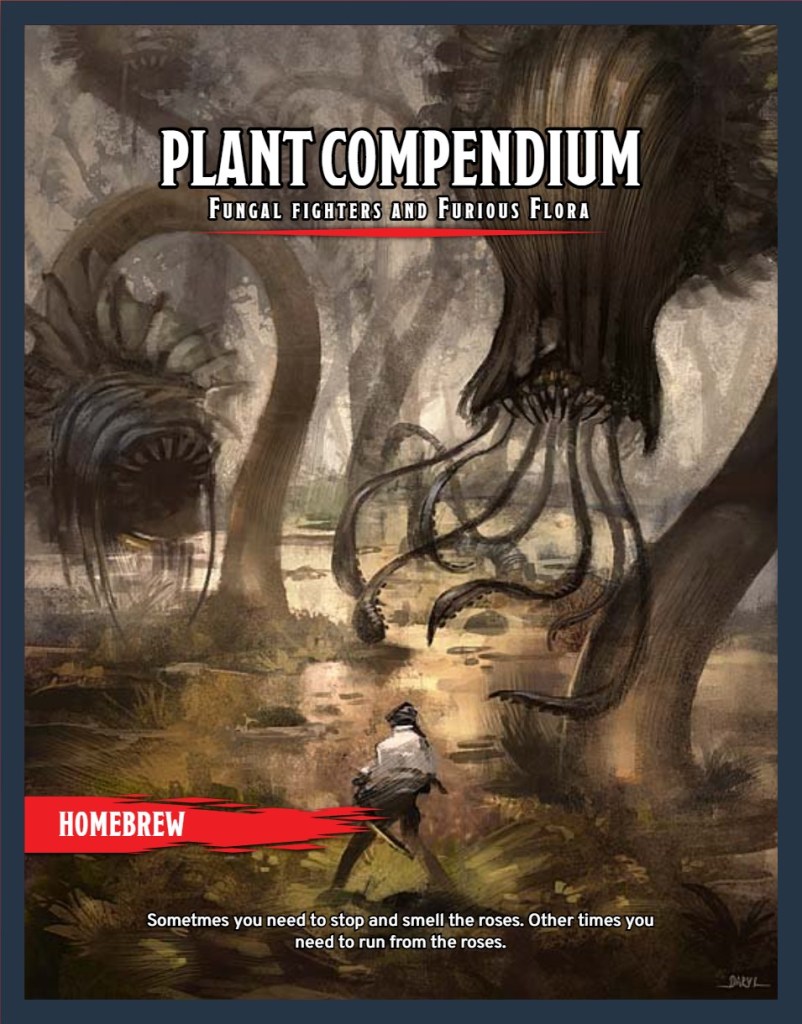
The first in the line up of furious flora, we have the Barkling, a much timid and weaker creature than many of the others within my collection. Much like the Ooze’s from the last post, Plants are simple minded creatures within a fight, often either static and slow moving creatures that support from the sidelines or more bruiser and tanky oriented creatures meant to take a hit in the frontlines. Plants could be considered the weakest and most overlooked monster category out of them all, as the absolute strongest in core D&D 5th edition is the Treant at CR 9, who can hit things up close, throw rocks, and animate nearby 1-2 trees into Animated Trees (CR 5) 1/day. Rather weak all in all and kind of boring in my opinion. A lot of the other plant and nature themed creatures would actually be considered Fey, but it feels weak and lazy to not have something more impressive than a literal walking-talking tree as the strongest plant monster in the book. Because of how limited, weak, and frankly uninteresting the core Plant creature roster is, it’s somewhat of an open door as there is not a real ruleset or guideline i have to follow in creation. Dragons for example almost always have Frightening Presence once they’re an adult, very rarely have any form of spellcasting (Gemstones and extraterrestrial dragons like Moon and Solar excluded), and always have a breath weapon of some kind. Most Plant creatures have a melee attack… and that’s kind of it. Again the Treant has the ability to awaken trees, and the Shambling Mound has Lightning Absorption, but these aren’t rules as opposed to one-off features, so with that I have taken several liberties for creating the plant compendium.
Barkling: The Overview

Being CR 2, Barklings are by no means difficult monsters to take down. With a meager 13 AC, vulnerability to Fire damage, and with meek 52 hit points, there is quite a lot that could quickly put a Barkling in the dirt, but that’s kind of the point. Barklings are not dangerous creatures nor boss entities that are designed to curb stomp parties, nor are they supposed to have some unique gimmick that makes them dangerous. Barklings were designed to be servitors for higher powers and aid those who have gotten lost and grown weak. If a party is in combat against a Barkling, there is likely more in the fray alongside a much bigger and more dangerous creature. With their frail defenses and mediocre offensive utility, Barklings lend themselves to a more supportive role over one of pure strength or insurmountable defense, where they can buff their allies and weaken their enemies.
- Stats and Skills: Nothing is really exceptional about the Barkling’s stat spread which only secures their spot in supportive sideliners. Nothing notably bad or good, with 15s as their highest stats in DEX and CON, Barklings are a bit scrappy and can take a few (non Fire damage) hits before they start needing to back off. Despite not having anything to excel in, the only stat Barklings suffer in is the CHA department, but at this level of play they don’t really need to have a good CHA score. Unless a player is going to try and Plane Shift the entire forest population, there is little concern or need for a super high CHA score. A +4 to Stealth allows Barklings to hide amongst forested areas, observing as others wonder through their groves. Being labeled True Neutral might be a bit incorrect as they would more closely align with the Lawful Neutral alignment. While often servants of peace
- Resistances, Immunities, and Senses: As mentioned before, a Barkling’s defenses are sparse, only having immunities to the Blinded, Charmed, and Frightened conditions while also having a Vulnerability to Fire damage. As far as I’m aware, this is the first creature in this series that has a vulnerability to a damage type, so here’s an explanation. A creature that has a vulnerability to a damage type takes double damage from that specific damage. So if a Barkling were to get hit by the Firebolt cantrip that dealt 6 Fire damage, the Barkling would instead take 12. While not masterminds, Barklings are not dumb and have enough mental capacity to be wary of spellcasters or those wielding weapons that deal fire damage as with even just a couple stray hits, they’re dead. Due to a lack of eyes (or face in general for that matter), Barklings rely on Blindsight over regular vision, meaning they do need to be decently close to aid allies/attack enemies which does play against their passive roles a bit.
Passive Abilities and Actions:

Camouflage. The Barkling has advantage on Dexterity (Stealth) checks made to hide in natural surroundings, such as forests or wooded areas.
Fitting for a creature comprised of wood and branches to be able to seamlessly hide in the foliage. A Barkling would much rather observe than instigate (unless ordered to do so by whatever it serves), so this allows it to do just that with their nice +4 bonus to Stealth checks on top of this.
Tree Stride. Once on each of its turns, the Barkling can use 10ft. of its movement to step into one living tree within its reach and appear a second living tree within 60ft. of the first tree, appearing in an unoccupied space within 5ft. of the second tree. Both trees must be Large sized or bigger.
This is arguably the strongest feature in a Barkling’s kit as it essentially teleport across a large section of the battle map for a fraction of it’s movement cost. the only restriction not making this broken is that it’s a once per turn ability. This is a great tool to either escape combat outright, easily outpacing most martial characters or quickly reposition to help an ally since this doesn’t cost an action. This also allows a group of Barklings to play a bit more spread out and distant than a typical supporter might, helping prevent all of them getting caught in 1 Fireball and instantly dyeing.

Sunlight Dependency. If the Barkling hasn’t been in sunlight for an hour or longer, its speed and hit points are halved. If the it hasn’t been in sunlight for 6 hours or longer, it must succeed on a DC 15 Constitution saving throw or fall to 0 hit points.
It repeats this save for every for every hour beyond 6 hours that it is not in sunlight. If it hasn’t been in sunlight fo 24 hours, it dies and cannot be revived.
This ability might need some extra clarification. The idea I had in mind is that even though they don’t have leaves to photosynthesize off of, Barklings are dependent on direct sunlight to be able to function and survive. I do think that with the fact days are typically 12 hours long, bumping the timer from 6 hours to 12 is a better fit as that way they have a chance to function during the night. I do like the idea of them being weaker in the dark and at night as it allows the party to circumvent Barklings almost entirely by sticking to caves or operating at night. Other than the extension the limit Barklings can go without sunlight before needing to make CON saves, I think the ability does it’s job just fine.

Puncture. Melee Weapon Attack: +4 to hit, reach 5ft., one target. Hit 15 (3d8 + 2) piercing damage
A basic attack for a basic creature. This damage is a tad bit high for this creature and lowering it down to 2d6 would allow the Barkling to fill that more supportive role that it’s designed for. Additionally, raising the range from 5 to 10ft. allows the Barkling a bit of freedom and safety by staying just out of range of most melee weapons, though they aren’t going to be typically trying to be in close-quarters combat all the time.
Spores. The Barkling unleashes a cloud of spores in a 15ft. radius centered on itself. Each creature within the area must succeed on a DC 12 Wisdom saving throw or become charmed by the Barkling. A charmed creature can repeat the saving throw at the end of each of tis turns, ending the effect on a success.
While not full overpowering control like some fungal spores can exhibit, this is meant to be a soothing balm more than anything. As a tradeoff for lowering the damage of Puncture, I think it’s fair to up the DC of the WIS save to either 13/14, but give it the caveat that:
– a.) It lasts for 1 minute (or until the creature saves)
– b.) Once a creature saves, they’re immune for the next 24 hours to any Barkling’s Spore feature.
With these changes, its a better incentive for Barklings to start fights off like this as opposed to immediately trying to melee down attackers with their Puncture feature.

Healing Touch (3/Day). The Barkling touches a willing creature, restoring 8 (2d6 + 1) hit points to it.
For their final ability, Barkling’s have a weaker version of Cure Wounds which they can do 3 times per day. Nothing crazy, but at lower levels of play this can help prolong a fight either for or against the party. At the end of the day, Barklings are supporters and meant to aid stronger allies and debuff their opponents, so this feels right in line.
Revisions:
All in all, this is near perfect for the kind of monster I wanted: something frail and weak that when alone poses little challenge, but is a threat only when working in greater numbers and alongside more powerful creatures. The big revisions I would make would again be rewording Sunlight Dependency to make it easier to comprehend and lowering the damage of Puncture and increasing its range to offset that nerf. Additionally, Spores needs to follow the changes listed above as well (stating a duration, increasing the DC, and making creatures who pass immune for 24 hours) to fully round out the revisions. There’s nothing egregiously bad about this statblock from what I can see, but any and all revisions are welcome.
The first of the plants might not be the craziest of entries, but that’s completely fine. Not everything needs to be a world ending calamity and it brings a lot of balance to have weaker creatures to utilize in combat. If everything was a fight to the death, it’d be a bit weird if common people with no gifts or magical traits could survive in the world. That said, tune in text time to see a powerful Undead Boss entity!
 The Speer-Head Lounge